30-45 days Truck Dispatcher Course
Truck Dispatcher Course Training in Tarn Taran
Industry Leader in Remote Logistics Training
Build Your Career in Truck Dispatching Course in Tarn Taran
Truck dispatching course in Tarn Taran is becoming an attractive career path for people who want to enter the logistics industry without needing to drive a truck themselves. With practical knowledge of load boards, route planning, broker communication, carrier management, and U.S. trucking operations, trained dispatchers can support carriers and manage day-to-day transportation activities from Tarn Taran, Punjab. Whether you are a student, a beginner, or someone interested in logistics and transportation, this course can provide useful knowledge about truck dispatch operations. As the trucking industry continues to evolve, the role of the dispatcher will also change. Modern dispatchers will need to understand both trucking operations and digital tools to help carriers find suitable freight, plan efficient routes, communicate with brokers, and keep shipments moving.
Growing Logistics Industry
Trucking remains a major part of the transportation and freight industry.
Work from Tarn Taran
Many dispatching activities can be handled remotely with the right tools and training.
Practical Skill-Based Career
earn industry-specific skills rather than relying only on academic qualifications.
Learn Real-World Operations
Understand load booking, rate negotiation, HOS, documentation, tracking, and delivery coordination.
Suitable for Beginners
Structured training can help beginners build foundational knowledge of U.S. trucking operations.
Low Entry Barrier
Truck dispatching does not require you to own or drive a truck; the role focuses on coordinating transportation operations.
Understand Dispatch Software
Get familiar with the digital tools and platforms commonly used to organize and manage dispatch operations.
Flexible Work Opportunities
Remote dispatching can provide flexibility in how and where certain administrative and communication tasks are performed.
Modern & Flexible Learning
Why Truck Dispatcher Training Works Best for Students in Tarn Taran
Truck dispatcher training in Tarn Taran can give students practical exposure to the growing logistics and transportation industry. Instead of learning only through theory, students can develop job-relevant skills related to U.S. trucking operations, load booking, communication, route planning, and carrier coordination.
- Affordable Fee Structure: Without heavy classroom maintenance overheads, we pass 100% cost savings to you with lower course fees.
- Learn a Career-Oriented Skill: Truck dispatching combines communication, computer, and logistics skills, making it a practical career option for students and freshers
- Practical Industry Training: Students learn through real-world dispatch scenarios instead of focusing only on classroom theory. This helps build confidence with everyday dispatcher tasks.
- Suitable for Freshers: You don't need previous trucking experience to start learning. The training covers the basics step by step, making it suitable for students, freshers, and career changers.
- Build Skills for the Global Trucking Industry: Learn the processes used in U.S. and Canadian trucking operations and develop skills that can be useful when applying for dispatcher and logistics-related roles.
- Build Confidence – Practical exercises help students become familiar with the terminology, workflow, and responsibilities of a dispatcher
Next batch forming now in Tarn Taran
Start your dispatcher training
Advance
6 Weeks Course Intermediate & Practical Learning
What You’ll Learn
- Load Board Training – Work with load boards through practical, real-world scenarios.
- Load Searching & Booking – Learn the complete process of finding, evaluating, and booking suitable loads.
- Carrier Communication – Develop professional communication skills for working with carriers and drivers.
- Rate Confirmation & Negotiation – Understand rate confirmations and practice basic freight rate negotiation.
- Route Planning & Time Zones – Learn route planning, pickup/delivery scheduling, and U.S. time zone management
- Dispatch Documentation – Understand essential dispatch documents and how to manage them correctly.
- Shipment Tracking – Learn to monitor shipments and provide timely status updates.
- Problem-Solving Skills – Practice handling common challenges such as delays, schedule changes, and load issues.
- Practical Confidence Building – Strengthen your skills and confidence through hands-on dispatch tasks and realistic scenarios.
Is this for you
Who this course is built for
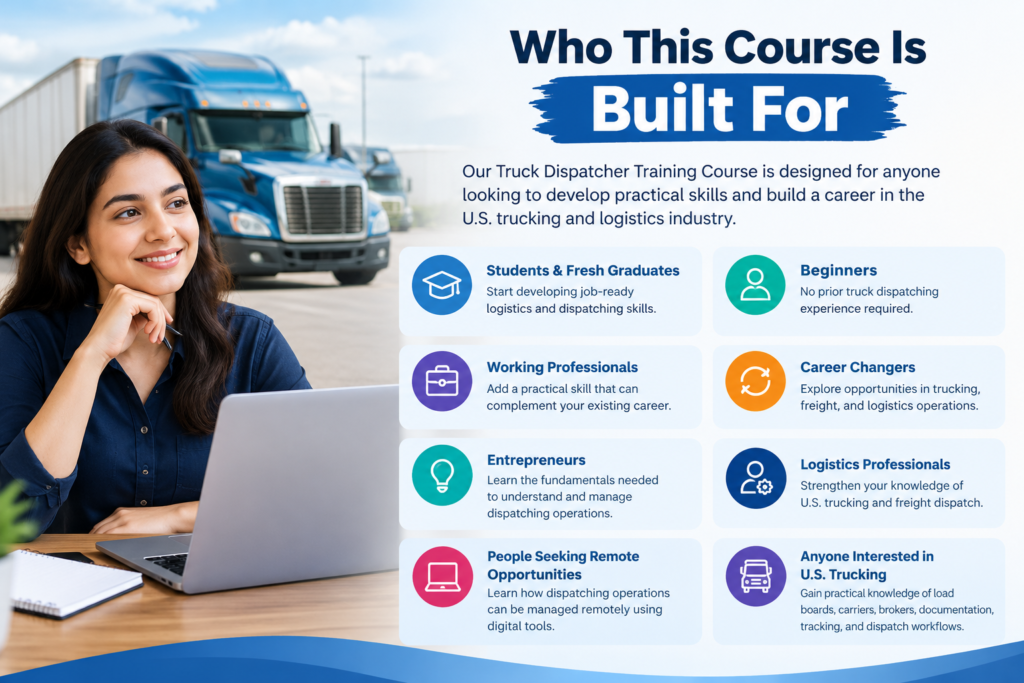
You don't need
- A commercial driving licence or any driving experience
- A background in transport, logistics or trucking
- A college degree — this is a practical, skill-based course
- Prior knowledge of the US or Canadian freight industry
You're a good fit if
- You're comfortable on the phone and don't mind talking to strangers
- You can read and write English well enough for emails and calls
- You're available for evening or night shifts to match US/Canada hours
- You want a skill you can use from home, without needing to travel abroad
After the course
Where dispatchers usually go from here
Typical starting points — actual pay depends on employer, shift and number of trucks managed.
| Stage | Common setup | What usually changes it |
|---|---|---|
| First 1–3 months | Fixed monthly pay, often paired with training or shadowing | Call confidence, accuracy with paperwork |
| 3–12 months | Fixed pay plus a small per-truck or per-load commission | Number of trucks handled, on-time load rate |
| 1+ years | Commission-heavy pay, sometimes managing several trucks or an owner-operator’s whole small fleet | Relationships with brokers, reliability, repeat business |
Ready to Start Your Truck Dispatching Career?
Take the First Step Toward a Career in Truck Dispatching
Why Choose Us?
Choose practical, industry-focused Truck Dispatcher Training in Tarn Taran, designed to help learners build real-world skills from anywhere in Punjab. Our online training makes it convenient for students and working professionals to learn without needing to travel to a physical classroom.
- 100% Online Training – Learn truck dispatching from the comfort of your home with live, practical sessions.
- Practical & Industry-Focused Learning – Work with real-world dispatch scenarios, load boards, documentation, tracking, and carrier communication
- Beginner-Friendly – Start learning from the basics, even if you have no previous truck dispatching experience.
- U.S. Trucking Focus – Understand the fundamentals of U.S. trucking operations, freight, carriers, brokers, and dispatch workflow
- Hands-On Training – Practice load searching, booking, rate confirmation, route planning, shipment tracking, and problem-solving.
- Flexible Online Learning – Learn without relocating or commuting, making the course suitable for students, professionals, and career changers
- Career-Oriented Skills – Develop practical knowledge that can support opportunities in truck dispatching, logistics coordination, and freight operations.
- Support Throughout the Course – Get guidance while practicing dispatch tasks and understanding real-world scenarios
Learn from Anywhere in Punjab – Join our online course from Amritsar, Jalandhar, Ludhiana, Mohali, Chandigarh, Patiala, Bathinda, Hoshiarpur, Pathankot, Moga, and across Punjab.
How Do Truck Dispatching / Freight Broker Services Work?
Truck dispatching and freight brokerage are two important parts of the trucking industry, but they perform different jobs. In simple terms, a truck dispatcher works on behalf of the carrier, while a freight broker connects shippers with carriers.
Understanding how both services work is important for anyone planning to build a career in truck dispatching, freight brokerage, or logistics.
How Freight Brokerage Works
A freight broker operates differently. A broker acts as an intermediary between a shipper that needs transportation and a motor carrier that can move the freight.
The process generally works like this:
1. Receive a Shipment Request: A shipper contacts a freight broker with information about the freight, pickup location, delivery location, equipment requirements, and timing.
2. Find a Suitable Carrier: The broker searches for an authorized carrier capable of transporting the shipment.
3. Negotiate Transportation: The broker and carrier agree on the transportation rate and shipment details.
4. Arrange the Shipment: The broker coordinates the necessary information between the shipper and carrier so the freight can be transported.
5. Track and Coordinate : The broker may communicate with the carrier and shipper during transportation to provide updates and resolve issues.
6. Complete the Transaction : Once the shipment is delivered, the necessary documentation and payment processes are completed.
FMCSA describes a broker as someone who arranges transportation by an authorized motor carrier for compensation.
Can a Dispatch Service Become a Freight Broker?
This is an important point for anyone entering the industry.
Not every activity performed by a dispatch service automatically requires broker authority. FMCSA’s guidance explains that whether a dispatch service is acting as a bona fide agent or requires broker authority depends on the specific relationship and activities involved. For example, a dispatch service working under a written agreement with a motor carrier and arranging freight through brokers can fall within the bona fide-agent framework. Certain activities—such as negotiating directly with shippers, accepting a shipment without a carrier and then finding a carrier, or allocating freight among multiple carriers—can indicate that broker authority is required.
Therefore, anyone planning to offer dispatch or brokerage services should understand the applicable FMCSA requirements and obtain professional legal or regulatory advice for their specific business model.
Why Learn Both Truck Dispatching and Freight Brokerage?
Learning how dispatchers and freight brokers interact gives students a better understanding of the complete freight transportation process.
With practical training, beginners can learn:
How load boards work
How to search and evaluate loads
How dispatchers communicate with brokers
How rate negotiations work
How carrier and broker paperwork is handled
How shipments are tracked
How dispatch software is used
How freight moves from pickup to delivery
The difference between dispatching and brokerage operations
For students interested in logistics careers, understanding both sides of the freight process can provide a stronger foundation for working with trucking companies, carriers, and logistics businesses.
How TrukyIQ Helps Students Learn Truck Dispatching
TrukyIQ focuses on practical truck dispatch training designed to help beginners understand how real-world USA and Canadian trucking operations work.
Students can learn through practical exercises covering load boards, load selection, rate negotiation, broker communication, documentation, shipment tracking, and dispatch workflows.
The goal is not simply to learn terminology. It is to develop practical skills and confidence that can be applied to real truck dispatching and logistics work.
Common questions
Frequently asked questions
What is truck dispatcher training?
Do I need a trucking or transport background to become a dispatcher?
No. Most people who join this course have never worked in trucking before. You don’t need a driving licence or transport experience — just basic computer skills, comfort speaking English on calls, and a willingness to learn how the US and Canadian freight industry works.
Can I really work as a dispatcher from Punjab for a US or Canadian company?
Yes. Dispatching runs on phone, email and load-board software, so location isn’t a barrier. Many dispatchers based in Punjab already work night shifts aligned with US and Canadian hours, either as remote employees or supporting owner-operators directly.
How long does the course take?
Most students finish the core training in four to six weeks, depending on whether they choose the weekday, weekend or evening batch.
What can I expect to earn as a new dispatcher?
It varies by employer and whether you’re salaried or on commission. New dispatchers typically start with a fixed monthly pay or a small per-truck commission, with income growing as you take on more trucks and prove yourself.
Is the training in English, Punjabi, or both?
Classes mix Punjabi and English, since that reflects how the job is actually done — but call scripts, emails and paperwork are practised in English, because that’s what carriers and brokers expect.