Understanding different types of freight loads is one of the first things a new truck dispatcher should learn. When working with brokers, shippers, and drivers, you will often hear terms like FTL, LTL, and partial loads.
Although all three involve transporting goods by truck, they are different in terms of shipment size, truck capacity, pricing, and how the freight is handled.
Knowing these differences can help dispatchers choose suitable loads, communicate better with brokers, and make smarter decisions for carriers.
What Is FTL (Full Truckload)?
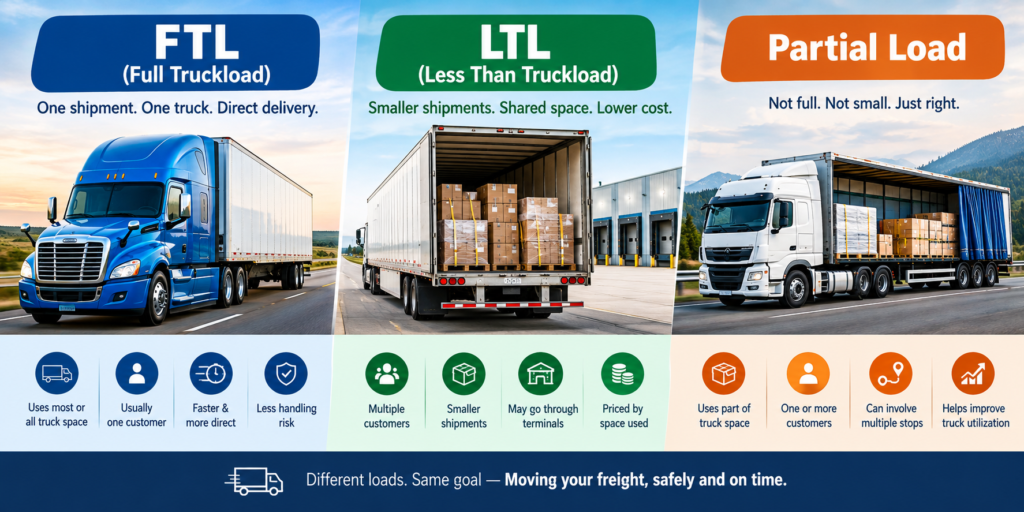
FTL stands for Full Truckload. It means the shipment generally uses most or all of a truck’s available capacity.
For example, a shipper may have enough freight to require an entire dry van, reefer, or flatbed. The truck is normally dedicated to that shipment rather than carrying several unrelated customers’ freight.
FTL shipments are commonly preferred when the load is large, time-sensitive, or requires direct transportation from the pickup location to the delivery location.
Common Benefits of FTL
- Faster and more direct transportation
- Fewer handling points
- Lower risk of freight being transferred between trucks
- Suitable for large shipments
- Often easier to plan for a dedicated truck
For a truck dispatcher, finding the right FTL load involves checking the pickup and delivery locations, equipment type, weight, commodity, appointment times, and rate.
What Is LTL (Less Than Truckload)?
LTL stands for Less Than Truckload. An LTL shipment does not require an entire truck.
Instead, freight from multiple customers can be transported on the same truck. Each shipper pays for the space their shipment uses.
For example, if one company has several pallets but not enough freight to fill a trailer, the shipment may move through an LTL network along with freight belonging to other customers.
LTL can be a practical option for smaller shipments that do not need a full truck.
Common Characteristics of LTL
- Multiple customers can share truck space
- Suitable for smaller shipments
- Freight may pass through terminals
- Transit can involve multiple handling points
- Pricing is generally based on shipment characteristics and space used
LTL operations can be more complex than a simple point-to-point FTL shipment because freight may need to be sorted, transferred, or routed through different terminals.
What Is a Partial Load?
A partial load falls somewhere between a full truckload and a small LTL shipment.
A partial load uses only part of a truck’s available capacity, but the shipment may be too large for a typical small LTL shipment or may be handled differently depending on the carrier and broker.
For example, a truck may have available space after completing one shipment. A dispatcher might find another compatible shipment along the route and use the remaining capacity.
This can help a carrier improve truck utilization and revenue while reducing empty miles.
| Feature | FTL | LTL | Partial Load |
|---|---|---|---|
| Truck Space | Mostly/all truck | Shared | Part of truck |
| Customers | Usually one | Multiple | One or more |
| Shipment Size | Large | Small/medium | Medium |
| Handling | Usually less | More handling possible | Depends on shipment |
| Route | Direct | Network-based | Can involve multiple stops |
| Dispatcher Focus | Rate, route & equipment | Shipment details & network | Capacity & route matching |
Which Load Type Is Better?
There is no single answer because the best option depends on the shipment and transportation requirements.
FTL is generally suitable when the shipment is large enough to justify a dedicated truck or requires direct transportation.
LTL can work well for smaller shipments that do not need an entire trailer.
Partial loads can be useful when there is available truck capacity and a dispatcher can combine compatible freight without creating unnecessary delays or extra miles.
For carriers, the goal is not simply to find any load. The goal is to find a profitable and practical load that fits the truck, route, schedule, and driver’s hours.
Why Dispatchers Need to Understand FTL, LTL and Partial Loads
For anyone learning truck dispatching, understanding freight types is an important part of working with load boards and brokers.
A dispatcher needs to evaluate questions such as:
- What type of equipment is required?
- How much does the freight weigh?
- How much trailer space is needed?
- Where is the pickup?
- Where is the delivery?
- Are there multiple stops?
- What is the offered rate?
- How many miles will the truck travel?
- Does the load fit the driver’s schedule?
- Will the load create unnecessary empty miles?
These details can directly affect the profitability and efficiency of a trucking operation.
Final Perspective:
FTL, LTL, and partial loads are three important concepts in the trucking and freight industry. FTL uses a dedicated truck, LTL combines smaller shipments, and partial loads use available truck capacity for shipments that don’t require the entire trailer.
If you’re starting a career in truck dispatching, learning how these freight types work will help you understand load boards, communicate with brokers, and make better decisions when booking loads.
With practical truck dispatch training, beginners can gradually learn how to evaluate loads, understand freight requirements, negotiate rates, and manage daily dispatch operations for the USA and Canada trucking markets.