The trucking industry is changing quickly, and Artificial Intelligence (AI) is becoming an important part of daily transportation operations. In 2026, AI is helping trucking companies, brokers, fleet owners, and dispatchers work faster, organize information, and make better decisions.
For truck dispatchers, AI is not simply about replacing people. It is becoming a tool that can help dispatchers save time, reduce repetitive work, and focus more on communication, load planning, and customer service.
If you are planning to become a truck dispatcher, understanding how AI works and how it can be used in dispatch operations can give you an advantage.
What Is AI in Truck Dispatching?
AI means using computer systems that can analyze information, recognize patterns, and help with certain tasks.
In truck dispatching, AI can be used for tasks such as:
- Finding and analyzing loads
- Comparing freight rates
- Planning routes
- Tracking shipments
- Predicting possible delays
- Organizing dispatch information
- Preparing documents
- Analyzing large amounts of data
- Helping with communication and scheduling
AI does not replace the basic responsibilities of a truck dispatcher. Instead, it can help a dispatcher complete many tasks more efficiently.
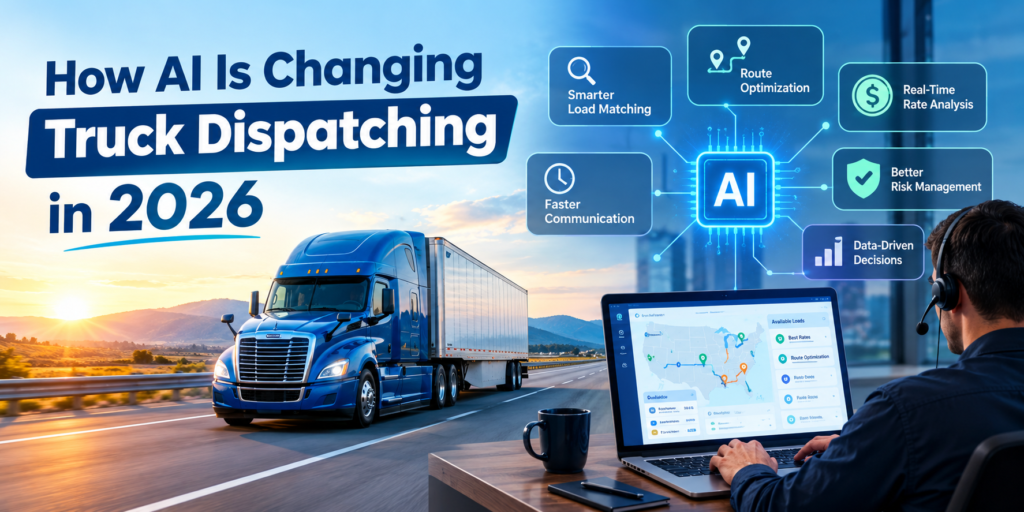
How AI Is Changing Truck Dispatching
Here are some of the major ways AI is changing dispatch work in 2026.
1. Faster Load Search
Finding the right load can take a lot of time. Dispatchers may need to check multiple load boards and compare different options.
AI-based tools can help analyze available information and identify loads that may match:
- Truck location
- Equipment type
- Pickup and delivery locations
- Schedule
- Distance
- Rate
- Driver preferences
This allows dispatchers to spend less time searching and more time making the final decision.
2. Better Route Planning
Route planning is an important part of dispatching.
AI can analyze information such as:
- Distance
- Traffic conditions
- Delivery schedules
- Weather conditions
- Road restrictions
- Historical travel patterns
This can help dispatchers identify possible problems before a truck starts its journey.
However, a dispatcher should still review the suggested route. AI recommendations are not always perfect.
3. Rate and Market Analysis
Freight rates can change depending on demand, location, equipment, fuel prices, capacity, and other market conditions.
AI can process large amounts of market information much faster than a person can manually review it.
| Information | How AI Can Help |
|---|---|
| Freight rates | Compare available rates |
| Lane history | Identify rate patterns |
| Market demand | Detect changes in demand |
| Truck availability | Understand capacity |
| Fuel costs | Consider operating costs |
| Previous loads | Analyze past performance |
A dispatcher can then use this information while deciding whether a load makes sense for a carrier.
4. Real-Time Tracking
Tracking a truck is already an important part of dispatching.
AI can analyze tracking information and identify possible delays.
For example, if a truck is moving slower than expected, an AI system may help identify that the delivery could be late.
The dispatcher can then contact the driver or broker and take action early.
5. Less Repetitive Paperwork
Truck dispatching involves many documents and records.
AI-powered software can help organize information from:
- Rate confirmations
- Load information
- Pickup and delivery details
- Carrier documents
- Invoices
- Shipment records
- Emails
This can reduce the amount of manual data entry.
However, dispatchers should always review important information before sending or submitting documents.
6. Better Communication
Communication is one of the most important skills for a dispatcher.
AI can help draft emails, organize messages, summarize information, and prepare communication.
For example, a dispatcher may use AI to create a professional message to a broker about a delayed shipment.
But the dispatcher should review the message before sending it.
AI can help with communication, but human judgment and professional communication are still essential.
AI Tools vs Traditional Dispatching
| Task | Traditional Method | With AI Support |
|---|---|---|
| Load searching | Manual checking | Faster data analysis |
| Route planning | Manual research | AI-assisted suggestions |
| Rate comparison | Manual comparison | Automated analysis |
| Tracking | Dispatcher monitors updates | AI can flag possible delays |
| Documentation | Manual entry | Automated assistance |
| Communication | Written manually | AI can assist with drafts |
| Data analysis | Time-consuming | Faster analysis |
AI does not completely change what a dispatcher does. It changes how efficiently the dispatcher can perform the work.
Benefits of AI in Truck Dispatching
AI can provide several benefits when used correctly.
1. Saves Time
AI can handle or assist with repetitive tasks, allowing dispatchers to focus on more important work.
2. Faster Decision Making
AI can process large amounts of information quickly and present useful patterns or suggestions.
3. Better Organization
Dispatchers deal with many loads, drivers, brokers, documents, and schedules. AI-based systems can help organize this information.
4. Helps Identify Problems Earlier
AI can analyze tracking and other information to identify possible delays or operational problems.
5. Reduces Repetitive Work
Tasks such as data entry, document organization, and basic communication can become easier with automation.
6. Supports Better Planning
AI can help dispatchers compare different options before choosing a load or route.
Disadvantages and Limitations of AI
AI also has limitations. A dispatcher should understand them before depending on AI.
| Disadvantage | What It Means |
|---|---|
| Incorrect information | AI can sometimes provide inaccurate results |
| Limited judgment | AI cannot fully understand every real-world situation |
| Data quality | Poor input can produce poor recommendations |
| Technology dependence | Too much dependence can weaken practical skills |
| Privacy concerns | Sensitive business information must be handled carefully |
| Human communication | AI cannot replace real relationships with drivers and brokers |
| Cost | Some advanced AI software may require paid subscriptions |
The most important point is simple:
AI should support a truck dispatcher, not replace the dispatcher’s judgment.
A good dispatcher should know the basics of trucking operations first and then learn how to use AI as a tool.
Will AI Replace Truck Dispatchers?
This is one of the biggest questions students have.
The answer is not simply yes or no.
AI can automate certain repetitive tasks, but truck dispatching involves many human decisions.
A dispatcher may need to:
- Talk with drivers
- Negotiate with brokers
- Handle unexpected problems
- Understand carrier requirements
- Manage schedule changes
- Communicate during delays
- Build professional relationships
- Make decisions when conditions change
These responsibilities require communication, experience, judgment, and problem-solving.
Therefore, the future is more likely to be about AI-assisted dispatchers rather than dispatchers completely disappearing.
Skills Truck Dispatchers Should Learn in 2026
Students entering the industry should focus on both traditional dispatch skills and modern technology.
| Skill | Importance |
|---|---|
| Load board knowledge | ⭐⭐⭐⭐⭐ |
| Rate negotiation | ⭐⭐⭐⭐⭐ |
| Broker communication | ⭐⭐⭐⭐⭐ |
| Route planning | ⭐⭐⭐⭐ |
| Freight documentation | ⭐⭐⭐⭐ |
| Tracking software | ⭐⭐⭐⭐ |
| Problem solving | ⭐⭐⭐⭐⭐ |
| AI tools | ⭐⭐⭐⭐ |
| Communication skills | ⭐⭐⭐⭐⭐ |
| Market understanding | ⭐⭐⭐⭐ |
Learning AI alone is not enough.
A successful dispatcher needs a combination of industry knowledge + practical skills + technology awareness.
How TrukyIQ Can Help Students?
At TrukyIQ, students can learn truck dispatching from a practical and career-focused perspective.
The goal is not just to teach students definitions or theory. Students need to understand how dispatch work is actually performed.
TrukyIQ can help students understand areas such as:
Practical Truck Dispatch Training
Students can learn the basic workflow of truck dispatching, including load searching, carrier communication, scheduling, tracking, documentation, and other important tasks.
Learn Modern Dispatch Technology
As technology changes, dispatchers need to understand modern tools and software.
Students can learn how technology, automation, and AI can support everyday dispatch work.
Learn Through Practical Examples
Instead of learning only from theory, students can work through realistic dispatch situations and understand how a dispatcher should respond.
Improve Communication Skills
Students can practice professional communication with drivers, brokers, and other parties involved in freight transportation.
Understand Rate Negotiation
Students can learn how freight rates work and what information should be considered before accepting a load.
Career-Focused Learning
TrukyIQ focuses on helping students build practical skills that can be useful when applying for truck dispatching and logistics-related opportunities.
The Future of Truck Dispatching
Truck dispatching will continue to evolve as technology becomes more advanced.
AI will likely become more common in:
- Load matching
- Route planning
- Tracking
- Data analysis
- Documentation
- Communication
- Freight market analysis
But technology will not remove the need for people who understand the trucking business.
The dispatcher of the future will need to know how to work with technology instead of competing against it.
Final Perspective
AI is changing truck dispatching in 2026 by making many tasks faster and easier. It can help dispatchers analyze information, find opportunities, monitor shipments, organize documents, and make better decisions.
At the same time, AI has limitations. It can make mistakes and cannot replace human communication, judgment, and problem-solving.
For students who want to enter the trucking and logistics industry, the best approach is to learn the fundamentals of dispatching first and then understand how modern AI and technology can support their work.
Learn the industry. Build practical skills. Understand the technology. Use AI as a tool.
That combination can help prepare students for the changing world of truck dispatching.
Frequently Asked Questions
Is AI replacing truck dispatchers in 2026?
AI is automating some repetitive tasks, but truck dispatching still requires communication, decision-making, negotiation, and problem-solving. AI is better viewed as a support tool for dispatchers.
Do truck dispatchers need to learn AI?
Learning basic AI tools and understanding how they can support dispatch work can be useful for modern dispatchers. However, students should first develop strong fundamentals in truck dispatching.
Can AI find loads for truck dispatchers?
AI-powered systems can help analyze load information and identify options based on factors such as location, equipment, schedule, and rates. The dispatcher should still review the information before making a decision.
Is truck dispatching still a good career in 2026?
Truck dispatching continues to evolve with technology. People with strong industry knowledge, communication skills, problem-solving abilities, and technology awareness can be better prepared for the changing logistics industry.
How does TrukyIQ prepare students for modern truck dispatching?
TrukyIQ focuses on practical truck dispatch training, including dispatch workflows, load boards, communication, freight documentation, rate negotiation, tracking, and modern technology. Students can build skills that are relevant to today’