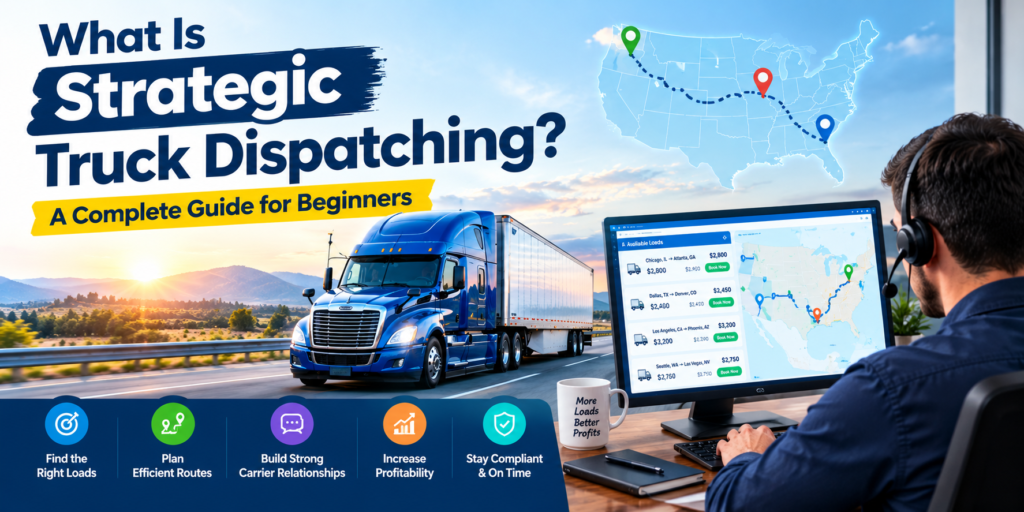
Truck dispatching is more than simply finding a load and giving the driver pickup and delivery details.
A good truck dispatcher needs to think ahead.
Strategic truck dispatching means using planning, market information, load selection, route management, communication, and technology to help a carrier operate efficiently and make better business decisions.
For beginners, understanding strategic dispatching can make it easier to see how professional dispatchers manage trucks, loads, drivers, brokers, and schedules.
What Is Strategic Truck Dispatching?
Strategic truck dispatching is a planned approach to managing freight and truck operations.
Instead of asking only:
“Can I find a load for this truck?”
A strategic dispatcher also asks:
- Is this load profitable?
- How many miles will the truck travel?
- How much deadhead will be involved?
- Where will the truck be after delivery?
- Is another good load available from that area?
- Does the pickup and delivery schedule work for the driver?
- Is the rate reasonable for the current market?
- Are there possible delays on the route?
The goal is to make better decisions before accepting a load.
Strategic Dispatching vs Basic Dispatching
| Basic Dispatching | Strategic Dispatching |
|---|---|
| Finds a load | Evaluates the complete load opportunity |
| Focuses on pickup and delivery | Looks at the entire trip |
| Accepts available freight | Compares multiple options |
| Checks rate | Considers rate, miles, costs and time |
| Plans one load | Thinks about the next load |
| Reacts to problems | Tries to identify problems early |
| Uses basic tools | Uses data and technology |
| Focuses on completing the trip | Focuses on efficiency and profitability |
Strategic dispatching does not mean making every decision complicated.
It means thinking before acting.
Why Is Strategic Truck Dispatching Important?
A truck can be busy and still not be profitable.
For example, a truck may complete several loads but travel too many empty miles, spend too much time waiting, or accept loads with poor rates.
Strategic dispatching helps a dispatcher look at the bigger picture.
The main goals can include:
- Reducing unnecessary empty miles
- Finding suitable loads
- Improving truck utilization
- Planning future loads
- Managing driver schedules
- Negotiating rates
- Reducing delays
- Improving communication
- Supporting carrier profitability
1. Strategic Load Selection
Finding a load is only the first step.
A dispatcher should compare different loads before recommending one to the carrier.
Important factors include:
- Pickup location
- Delivery location
- Total miles
- Deadhead miles
- Rate
- Rate per mile
- Pickup and delivery times
- Equipment requirements
- Expected travel time
- Potential next load
Example
Suppose a truck has two available options:
| Factor | Load A | Load B |
|---|---|---|
| Loaded Miles | 500 | 650 |
| Deadhead | 150 | 30 |
| Rate | $1,500 | $1,750 |
| Total Miles | 650 | 680 |
| Rate / Total Mile | $2.31 | $2.57 |
| Delivery Area | Low demand | Stronger demand |
At first glance, Load B may appear better because it pays more.
But a strategic dispatcher looks at all the numbers, not just the total rate.
The final decision can also depend on driver hours, fuel costs, appointment times, equipment, and what freight may be available after delivery.
2. Reducing Deadhead Miles
Deadhead miles are miles driven without a paying load.
Reducing unnecessary deadhead is an important part of strategic dispatching.
For example, if a truck delivers in City A, the dispatcher can look for another suitable load near City A instead of sending the truck hundreds of miles empty.
A dispatcher should think:
Current delivery → Next available freight → Next destination
rather than treating every load as a separate trip.
3. Planning the Next Load
One of the biggest differences between basic and strategic dispatching is thinking ahead.
Before a truck reaches its delivery location, a dispatcher can begin looking for the next suitable load.
This can help reduce:
- Waiting time
- Empty miles
- Unnecessary repositioning
- Driver downtime
The dispatcher should understand where the truck will be and what freight may be available there.
4. Understanding Freight Markets
Freight markets can change.
Demand may be stronger in one area and weaker in another.
A strategic dispatcher pays attention to:
- Freight demand
- Available trucks
- Load availability
- Rates
- Seasonal trends
- Major shipping areas
- Equipment demand
Market knowledge can help dispatchers make better decisions instead of simply choosing the first available load.
5. Rate Negotiation
Rate negotiation is an important dispatcher skill.
A strategic dispatcher should understand that the highest possible rate is not always the only goal.
The dispatcher should consider the complete trip.
For example:
Load rate → Total miles → Deadhead → Time → Fuel/operating costs → Next load opportunity
A load with a slightly lower rate may sometimes make more sense if it has lower deadhead and puts the truck in a strong freight market.
6. Route Planning
Strategic dispatching also involves planning routes carefully.
A dispatcher should consider:
- Distance
- Traffic
- Weather
- Road conditions
- Delivery appointments
- Driver availability
- Truck restrictions
- Possible delays
Technology can help with route planning, but the dispatcher should still review the information and use practical judgment.
7. Driver Communication
A strategic dispatcher needs good communication skills.
Dispatchers communicate with:
- Drivers
- Brokers
- Shippers
- Receivers
- Carriers
- Customers
The dispatcher needs to provide clear information and respond professionally when something changes.
For example, if a driver experiences a delay, the dispatcher may need to:
- Understand the reason for the delay.
- Check the delivery appointment.
- Contact the broker or receiver if necessary.
- Update the relevant parties.
- Look for a solution.
Good communication can prevent a small problem from becoming a larger operational issue.
8. Using Technology in Strategic Dispatching
Technology has become an important part of modern truck dispatching.
Dispatchers may work with:
- Load boards
- GPS and tracking systems
- Transportation management systems
- Electronic logging information
- Route planning software
- Communication platforms
- Freight market data
- AI-powered tools
AI can also help analyze information and automate some repetitive tasks.
However, technology should support the dispatcher rather than replace practical judgment.
Technology and Strategic Dispatching
| Technology | Possible Use |
|---|---|
| Load Boards | Find available freight |
| GPS Tracking | Monitor truck location |
| Route Software | Plan routes |
| TMS | Organize transportation operations |
| AI Tools | Analyze information and assist with repetitive tasks |
| Communication Tools | Communicate with drivers and brokers |
| Freight Data | Understand market conditions |
9. Measuring Dispatcher Performance
Strategic dispatching should be measurable.
A dispatcher can monitor important performance indicators such as:
| KPI | Why It Matters |
|---|---|
| Revenue per mile | Helps evaluate earnings |
| Total miles | Shows truck utilization |
| Deadhead percentage | Measures empty movement |
| Loaded miles | Shows productive movement |
| Waiting time | Identifies lost productivity |
| Loads per week | Measures activity |
| On-time delivery | Measures service performance |
| Average rate | Helps track freight performance |
The exact KPIs can vary depending on the carrier and type of operation.
Common Mistakes Beginners Make
New dispatchers often focus too much on finding a load quickly.
Here are some common mistakes:
1. Choosing the Highest Rate Without Checking Miles
A higher total rate does not automatically mean a better load.
2. Ignoring Deadhead
A good-looking load can become less attractive when a truck has to travel a long distance empty.
3. Thinking About Only One Load
A dispatcher should consider where the truck will be after delivery.
4. Poor Communication
Incomplete or unclear information can create unnecessary problems.
5. Ignoring Driver Constraints
Driver schedules, hours, preferences, and equipment requirements matter.
6. Depending Too Much on Technology
Software can provide useful information, but the dispatcher still needs to make the final business decision.
A Simple Strategic Dispatching Process
For beginners, strategic dispatching can be understood through this simple workflow:
Step 1: Know where the truck is.
↓
Step 2: Understand the truck and driver requirements.
↓
Step 3: Search for suitable loads.
↓
Step 4: Compare rates, miles, deadhead, time, and destination.
↓
Step 5: Check the route and appointment schedule.
↓
Step 6: Negotiate with the broker when appropriate.
↓
Step 7: Confirm the load and documents.
↓
Step 8: Track the shipment.
↓
Step 9: Communicate updates and handle problems.
↓
Step 10: Start planning the next load before delivery.
This is the basic idea behind strategic truck dispatching.
Benefits of Strategic Truck Dispatching
Strategic dispatching can provide several advantages.
Better Load Decisions
Dispatchers can compare multiple factors before recommending a load.
Lower Empty Miles
Better planning can help reduce unnecessary deadhead movement.
Better Time Management
Planning ahead can reduce unnecessary waiting.
Improved Truck Utilization
The goal is to keep the truck working efficiently while respecting driver and operational requirements.
Better Communication
A planned approach makes it easier to keep drivers and brokers informed.
Better Long-Term Planning
Dispatchers can think beyond the current load and consider what happens next.
Challenges of Strategic Truck Dispatching
Strategic dispatching also has challenges.
| Challenge | Why It Can Be Difficult |
|---|---|
| Changing freight rates | Market conditions can change quickly |
| Limited load availability | Good freight may not always be available |
| Driver preferences | Every driver may have different requirements |
| Traffic and weather | Conditions can change unexpectedly |
| Broker negotiations | Rates and terms may vary |
| Delivery delays | Delays can affect future planning |
| Data accuracy | Incorrect information can lead to poor decisions |
| Multiple trucks | Managing several trucks requires strong organization |
A good dispatcher learns to adjust the plan when conditions change.
What Skills Do You Need for Strategic Truck Dispatching?
Beginners should develop a combination of technical and communication skills.
Important Skills
- Load board knowledge
- Freight market understanding
- Rate negotiation
- Route planning
- Communication
- Problem-solving
- Time management
- Basic calculations
- Documentation
- Tracking software
- AI and technology awareness
- Decision-making
You do not need to know everything on your first day.
These skills can be developed through structured learning and practical experience.
How TrukyIQ Can Help Students Learn Strategic Truck Dispatching
At TrukyIQ, students can learn truck dispatching with a practical and career-focused approach.
The goal is to help students understand how dispatchers actually think and work, rather than only memorizing trucking terms.
Students can develop knowledge in areas such as:
Practical Load Planning
Understand how to evaluate loads based on rate, miles, deadhead, timing, and destination.
Rate Negotiation
Learn the basics of communicating with brokers and understanding freight rates.
Load Board Training
Learn how load boards are used to search for and evaluate freight opportunities.
Route and Shipment Planning
Understand how routes, pickup appointments, delivery schedules, and tracking fit into the dispatch process.
Realistic Dispatch Scenarios
Practice situations that a dispatcher may face when communicating with drivers and brokers.
Technology and AI Awareness
Understand how modern software, automation, and AI can support dispatching work.
Career Preparation
Build practical knowledge and communication skills that can help students prepare for truck dispatching and logistics-related opportunities.
Strategic Truck Dispatching Is About Thinking Ahead
Strategic truck dispatching is not about finding the most loads.
It is about finding and managing the right loads.
A good dispatcher looks beyond today’s pickup and asks:
Where is the truck going?
How much will the trip really cost?
How many empty miles are involved?
What will the next load look like?
Is the driver able to complete the trip comfortably and on schedule?
Does the overall plan make business sense?
These questions help turn basic dispatching into strategic dispatching.
Final Thoughts
Strategic truck dispatching combines planning, freight knowledge, communication, technology, and decision-making.
For beginners, the most important lesson is to stop thinking about dispatching as simply finding loads.
Instead, think about the complete journey:
Truck → Load → Route → Driver → Delivery → Next Load
When these pieces are planned together, dispatchers can make more informed decisions and help carriers operate more efficiently.
For students entering the trucking industry, learning strategic dispatching can be a valuable step toward becoming a more confident and capable truck dispatcher.
Frequently Asked Questions
What is strategic truck dispatching?
Strategic truck dispatching is the process of planning and managing loads, routes, drivers, schedules, and freight decisions with the goal of improving efficiency and supporting carrier profitability.
Is strategic dispatching different from normal truck dispatching?
Yes. Basic dispatching may focus mainly on finding and managing a load. Strategic dispatching looks at the complete trip, including rates, miles, deadhead, timing, destination, and the next load opportunity.
How can a dispatcher reduce deadhead miles?
A dispatcher can look for suitable freight near the truck’s delivery location and plan future loads before the current load is completed.
Does strategic dispatching require AI?
No. AI is not required to become a truck dispatcher. However, understanding modern technology and AI tools can help dispatchers work more efficiently.
What should beginners learn first?
Beginners should start with truck dispatch fundamentals, load boards, freight terminology, rate calculations, communication, route planning, documentation, and basic negotiation.
Can TrukyIQ help beginners learn truck dispatching?
Yes. TrukyIQ focuses on practical, career-oriented truck dispatch training designed to help beginners understand real-world dispatch workflows, communication, load planning, technology, and other essential skills.