Truck dispatching is an important part of the trucking and logistics industry. A truck dispatcher helps drivers find loads, communicates with freight brokers, manages delivery schedules, and keeps transportation operations running smoothly.
If you want to start a career in US truck dispatching, developing the right skills is an important first step. You do not always need a college degree to become a truck dispatcher, but you need good communication, computer knowledge, time management, and an understanding of how the trucking industry works.
In this article, we will explain the essential skills for a truck dispatcher and how beginners can develop them.
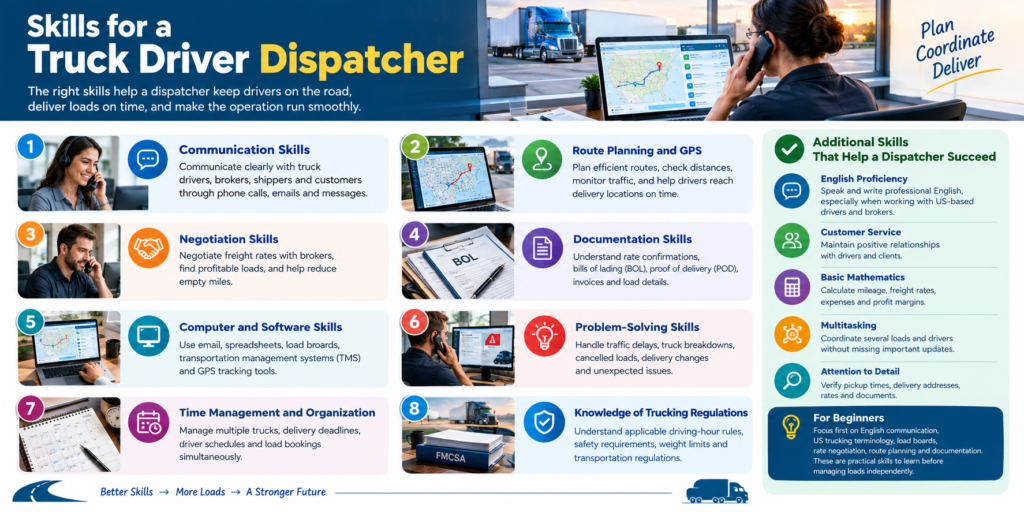
1. Good English Communication Skills
English communication is one of the most important skills for a truck dispatcher, especially when working with US trucking companies.
Dispatchers regularly speak with freight brokers, truck drivers, customers, and other logistics professionals. They need to understand load details, confirm pickup and delivery times, and provide shipment updates.
A truck dispatcher should be able to:
- Make professional phone calls.
- Understand brokers’ questions and instructions.
- Send clear emails and messages.
- Explain delays and delivery updates.
- Communicate politely during difficult situations.
You do not need a perfect American accent. Clear communication, confidence, and a good understanding of spoken English are more important.
2. Knowledge of the US Trucking Industry
A good dispatcher understands how the trucking industry works. Beginners should learn the roles of carriers, owner-operators, freight brokers, and shippers.
They should also understand different types of trucks, including dry vans, reefer trucks, flatbeds, and box trucks.
Knowing the basics helps dispatchers select suitable loads for available trucks and understand the requirements of different shipments.
For example, a refrigerated truck may be needed for temperature-sensitive goods, while a flatbed may be suitable for certain construction materials.
3. Load Searching and Booking Skills
Finding the right load is one of the main responsibilities of a truck dispatcher.
Dispatchers use load boards and other freight platforms to find available shipments that match a truck’s location, equipment type, schedule, and destination.
When searching for loads, they should check:
- Pickup and delivery locations.
- Available pickup and delivery dates.
- Total miles and estimated driving time.
- Freight rate and rate per mile.
- Truck and trailer requirements.
- Commodity details and special instructions.
A dispatcher should compare different options rather than selecting a load based only on its total payment. The goal is to find suitable loads that help the carrier operate profitably.
4. Rate Negotiation Skills
Rate negotiation is another valuable skill for truck dispatchers.
Freight rates can vary depending on the route, equipment, freight demand, timing, and other market conditions. Dispatchers may communicate with brokers to discuss the offered rate and request better terms.
To negotiate effectively, a dispatcher should understand the route, estimated miles, market conditions, and the carrier’s operating costs.
Professional negotiation involves asking clear questions, explaining the requested rate, and maintaining a respectful relationship with brokers.
The aim is not simply to get the highest rate. It is to find a load that makes business sense for the carrier.
5. Computer and Technical Skills
Modern truck dispatching depends on computers and online tools. Dispatchers should be comfortable using common software and digital platforms.
Useful technical skills include:
- Using email and online communication tools.
- Working with Microsoft Excel or Google Sheets.
- Searching for loads on freight platforms.
- Updating shipment information in dispatching software.
- Preparing and organising digital documents.
- Using GPS and route-planning tools.
Learning these tools can help beginners complete daily tasks more quickly and accurately.
6. Time Management and Organisation
Truck dispatchers often manage multiple loads and drivers at the same time. They must keep track of pickup appointments, delivery deadlines, broker instructions, and shipment updates.
Good time management helps prevent missed appointments and unnecessary delays.
A dispatcher should maintain an organised record of every load, including its current status, important contact details, pickup time, delivery time, and pending tasks.
Using a calendar, spreadsheet, or transportation management system can make this work easier.
7. Problem-Solving Skills
Unexpected problems are common in transportation. A truck may face traffic, bad weather, mechanical issues, loading delays, or a change in delivery appointments.
A skilled dispatcher stays calm, gathers the necessary information, and communicates with the driver and broker to find a practical solution.
For example, if a driver reports that a delivery will be late, the dispatcher should inform the relevant parties, check the revised estimated arrival time, and help coordinate the next steps.
Good problem-solving is about responding quickly without making promises that cannot be kept.
8. Knowledge of Routes and Geography
Truck dispatchers should have a basic understanding of US geography, including major cities, states, highways, freight lanes, and common transportation routes.
This knowledge helps them compare loads and understand how far a truck may need to travel.
Dispatchers should also consider driving time, traffic, weather, tolls, and delivery appointments when planning shipments.
Remember that the shortest route is not always the most practical route for a commercial truck. Truck restrictions, vehicle dimensions, and applicable regulations must also be considered.
9. Document Management Skills
Truck dispatching involves several important documents. Dispatchers should understand the purpose of common freight paperwork and know how to organise it properly.
Common documents include:
- Rate confirmation: Records the agreed shipment details and freight rate between the relevant parties.
- Bill of lading (BOL): Documents the freight being transported and provides shipment information.
- Proof of delivery (POD): Helps confirm that a shipment has been delivered.
- Invoice: Used to request payment for transportation services.
- Load details: Include pickup and delivery information, contact details, and special instructions.
Accurate paperwork helps reduce confusion and supports smoother payment and record-keeping processes.
10. Customer Service and Relationship Building
Truck dispatchers work with different people throughout the day. Building professional relationships with drivers, brokers, and carriers can make daily operations easier.
A good dispatcher responds to messages, provides accurate updates, follows agreed instructions, and handles disagreements professionally.
Trust develops when people know they can rely on your communication and follow-through.
Strong working relationships can also support long-term business opportunities.
11. Understanding Trucking Regulations and Safety
Truck dispatchers should understand the basic safety and operating rules relevant to the loads they manage.
For US trucking, this may include familiarity with hours-of-service requirements, electronic logging devices (ELDs), commercial vehicle restrictions, and appointment requirements.
Dispatchers should never pressure drivers to violate safety rules or exceed legally permitted driving limits to meet a delivery schedule.
A dispatcher who understands the importance of safety can help coordinate realistic schedules and support responsible transportation operations.
12. Multitasking and Attention to Detail
Dispatchers frequently switch between phone calls, load searches, emails, driver updates, and document management.
The ability to manage several tasks without losing important details is essential.
Small mistakes, such as entering the wrong pickup date or delivery address, can create costly problems. Before confirming a load, dispatchers should carefully review the details and make sure everyone has the correct information.
How Can Beginners Develop Truck Dispatcher Skills?
If you are new to truck dispatching, you can start by following these practical steps:
- Learn the basic terms used in the US trucking and freight brokerage industry.
- Practise professional English phone conversations and email writing.
- Study sample loads and learn how to calculate miles and rates per mile.
- Understand how load boards and dispatching software work.
- Practise preparing rate confirmations and maintaining load records.
- Learn basic US geography, major freight routes, and relevant safety requirements.
- Use real-world scenarios to practise handling delays, cancellations, and rate negotiations.
Practical training can help you understand how these skills work together during a typical dispatching shift. Focus on building confidence through practice instead of trying to learn everything in one day.
Frequently Asked Questions
What are the most important skills for a truck dispatcher?
The most important skills include English communication, load searching, rate negotiation, time management, computer knowledge, problem-solving, and understanding the trucking industry.
Can I become a truck dispatcher without experience?
Yes. Beginners can learn the fundamentals through study, practical exercises, and entry-level opportunities. Real-world experience helps develop better judgment and confidence.
Do truck dispatchers need good English?
Yes, especially when working with US trucking companies. Dispatchers need to understand spoken English, communicate clearly over the phone, and write professional emails and messages.
Do I need to know how to drive a truck?
No. A truck dispatcher generally manages loads, schedules, communication, and paperwork rather than driving the truck. However, understanding trucking operations and driver requirements is helpful.
Can I work as a truck dispatcher from India?
Yes, some companies offer remote dispatching or logistics support opportunities to people in India. Applicants should develop relevant skills, understand US trucking operations, and be prepared for the working hours required by their employer.
How long does it take to learn truck dispatching?
You can learn basic concepts in a relatively short period, but developing confidence in load booking, negotiation, documentation, and problem-solving requires regular practice. The time needed depends on your learning pace and prior experience.
Conclusion
Becoming a successful truck dispatcher requires more than finding loads. You need to communicate clearly, understand freight rates, manage schedules, organise paperwork, and handle unexpected problems.
For beginners who want to enter the US trucking and logistics industry, developing these skills can provide a strong foundation. Start with the basics, practise real-world situations, and keep improving your knowledge of dispatching tools and industry operations.
A good truck dispatcher helps drivers stay informed, carriers manage their business, and shipments move as smoothly as possible.